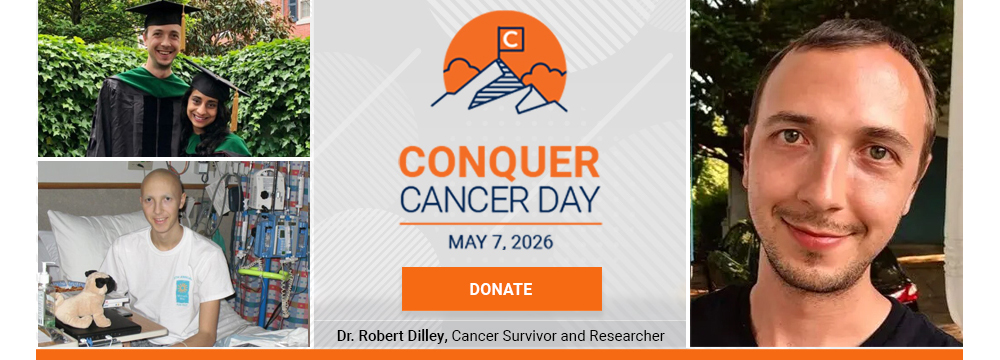
At the heart of progress in cancer care lies research, a necessity Robert Dilley knows firsthand. Having navigated a cancer journey from both sides of the stethoscope, he understands the urgent need for breakthroughs better than most.


As a physician-scientist, Dr. Dilley understands that today’s treatments exist after years of scientific work. As a cancer survivor, he also understands how much it matters that those options are there at precisely the right moment.
Today, his work in oncology and his support of Conquer Cancer are shaped by both perspectives.
Research that arrived when he needed it
Dr. Dilley’s relationship with cancer research did not begin in a lab or lecture hall. It began when he was 18 years old and preparing to start college, when what seemed like lingering flu symptoms led to bloodwork and then to an abrupt hospital admission.
The diagnosis was acute myeloid leukemia (AML), a rare and aggressive blood cancer. His plans for the fall semester were quickly replaced by long days in a hospital room, grappling with fear, uncertainty, and information that arrived faster than he and his family could process it.
His outcome depended on access to the clinical trial of an experimental antibody-drug therapy alongside standard chemotherapy. At the time, the trial was promising but unproven. Enrolling meant placing trust in a treatment that had been carefully developed but not yet widely used, which is a difficult reality for any patient, and especially for someone so young.
Over time, his therapy would become the first FDA approved drug of its kind, opening the door to a class of treatments now used across multiple cancers.
"In those long hours, I didn't know that thousands of people I would never meet were already looking out for me. Their support for clinical trials was the reason a new treatment was available for me when I needed it most,” he said about his lifesaving trial two decades ago.
Choosing a path shaped by experience
After treatment, Dr. Dilley entered college with a changed sense of direction. He wanted to become an oncologist and join the field that had given him a second chance.
He went on to study at Johns Hopkins University and the University of Pennsylvania, followed by training at Massachusetts General Hospital and the Dana-Farber Cancer Institute. At each stage, he saw more clearly how cancer care advances. Discoveries are tested, refined, and sometimes fail before eventually changing practice.
As an ASCO member, Dr. Dilley has seen firsthand the realities behind that work. Early-career researchers need support to test ideas that may not yet attract major funding. Translational studies require sustained commitment to move discoveries toward patients. Clinical trials depend on infrastructure, expertise, and time.
At Conquer Cancer, supporting that early momentum is central to our mission.
Paying progress forward
When Dr. Dilley speaks with someone facing a new diagnosis, he remembers what it felt like sitting on the other side of the conversation. He remembers absorbing complex information while being overwhelmed and hopeful all at once.
That memory influences how he listens, how he communicates, and how he thinks about the future his patients may be imagining for themselves. It also shapes his belief that research and patient care are inseparable pursuits. This drives not only Dr. Dilley’s support of Conquer Cancer but our work as an organization to improve care for every patient, everywhere.